
What is the project about?
With their wide range of applications, quantum technologies help address key societal challenges and thus contribute to the sustainable and forward-looking development of our society.
However, equal participation of highly qualified women in quantum technologies has not yet been achieved, as women remain severely underrepresented in precisely those STEM fields that lead to research and development work in quantum technologies, such as physics, computer science, and certain engineering disciplines. Furthermore, many excellent women in quantum technologies are less visible than their male colleagues.
This lack of visibility affects both visibility and recognition within the academic community — as reflected, for example, in honors or appointments to high-level leadership positions — and outside the academic sphere, in the general public, the business world, politics, and the media.
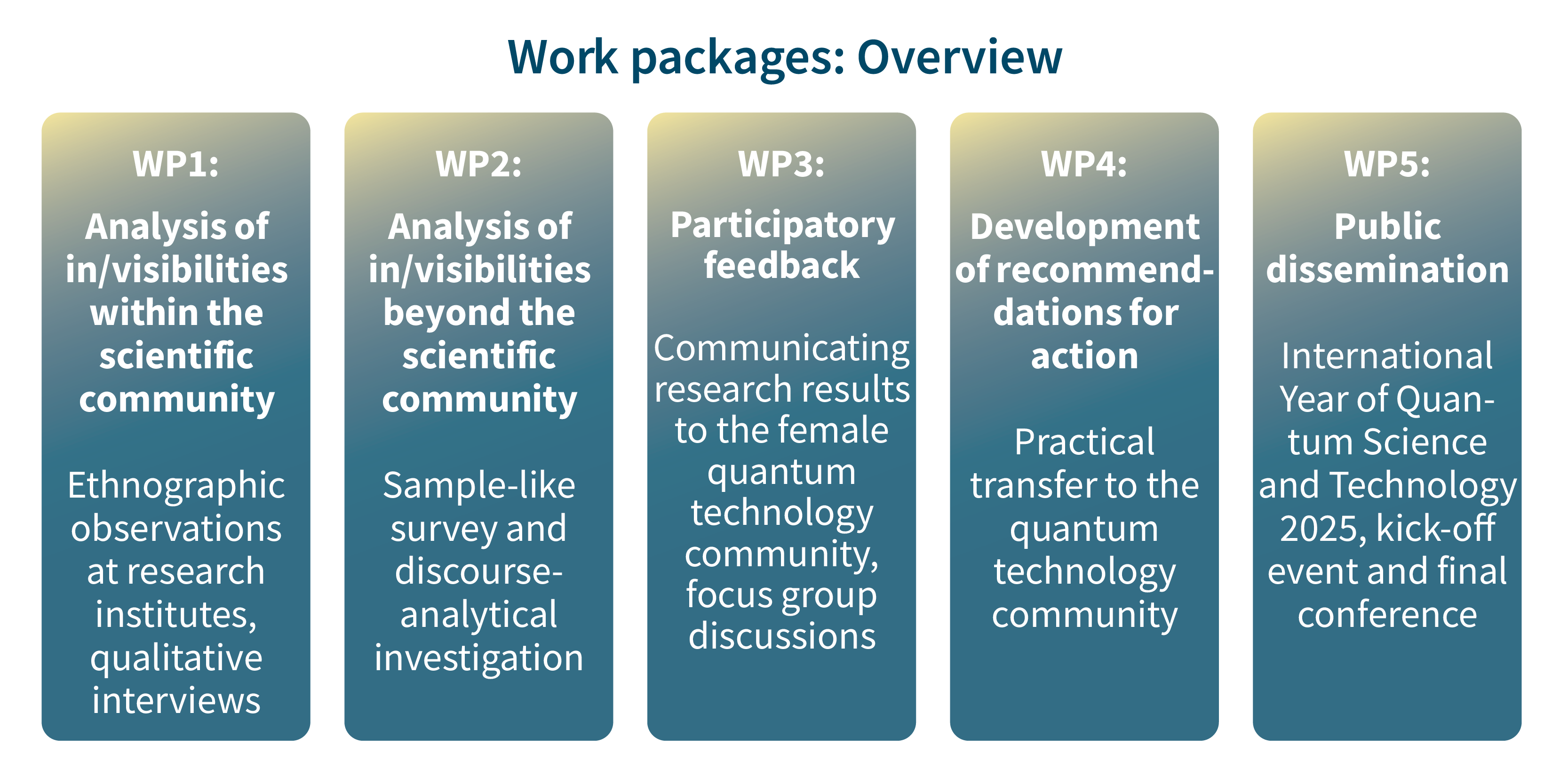
We investigate the mechanisms by which women in quantum technologies are made visible or invisible and kept in or out of the public eye. We translate our findings into strategies for visibility within and beyond the field, with the involvement of established leaders, high-performing women, and high-potential women, as well as their networks.
Our goal is to develop effective and sustainable strategies and recommendations for action at the structural level in order to strengthen and improve the visibility of women in quantum technologies, both within and beyond the field.
What do we want to achieve?
In addition to conducting social science research on the social mechanisms of recognition and visibility within academic communities, we aim to develop effective and sustainable strategies and to derive recommendations for action at the structural level. These recommendations for action should then strengthen and improve the visibility of women in quantum technologies, both within and outside their respective fields.
Who is our research directed at?
We primarily target the professional communities in quantum technology and the related scientific fields, particularly physics, computer science, and certain engineering disciplines. In addition, the strategies and recommendations developed in the project will be made available as an adaptable model for other key technologies as well.
How do we conduct our research?
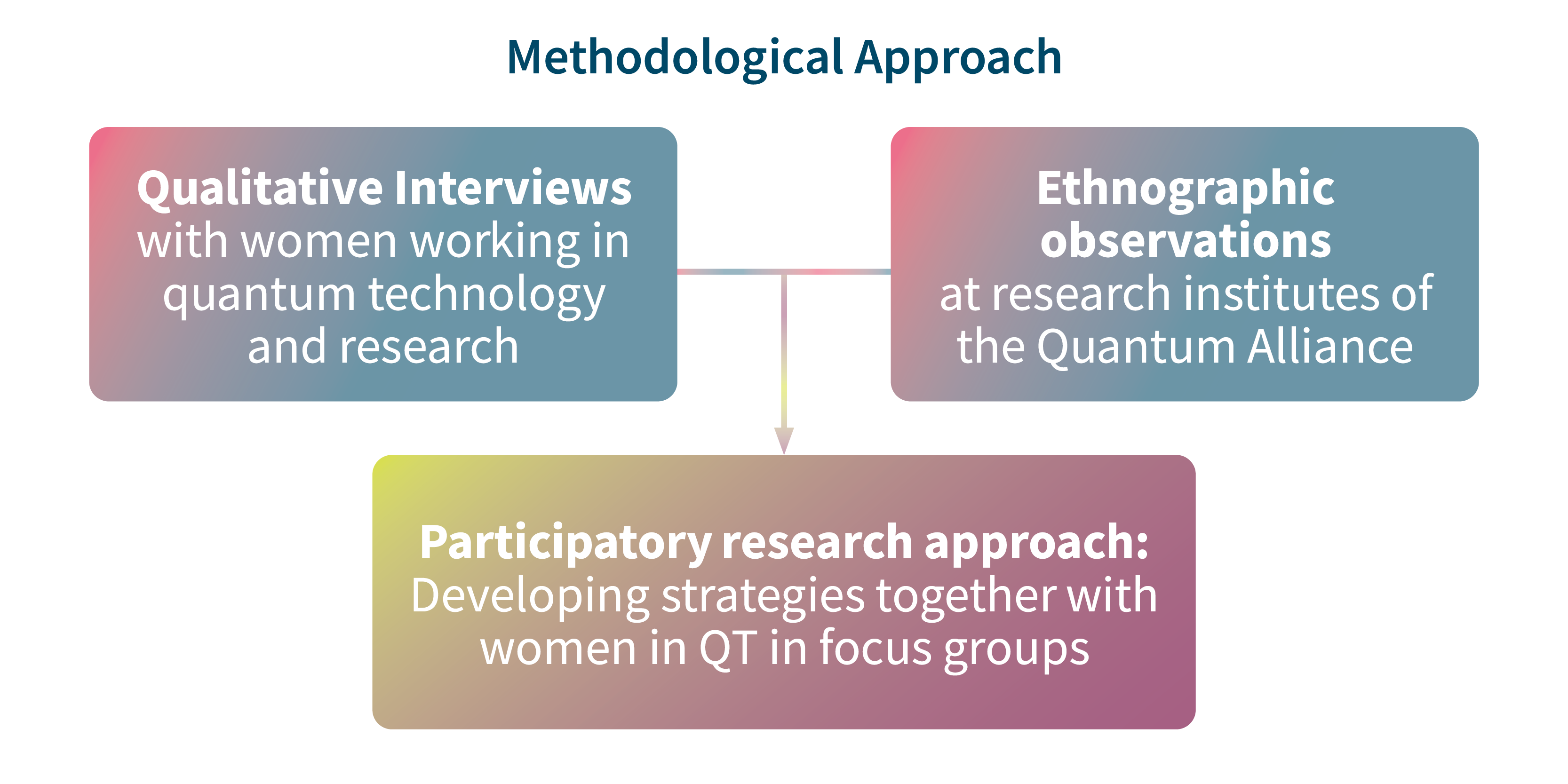
We conduct interviews and focus group discussions with women working in quantum technology and research, as well as participant observation at research institutes within the Quantum Alliance. Together with these women, we aim to use the findings to develop recommendations and strategies for improving the visibility of women in quantum technologies, both within and outside their respective fields.
How do we conduct interviews?
We conduct qualitative social science interviews with female researchers. The protection of the interviewees and data privacy are our top priorities.
The interviews are recorded. They are then transcribed and anonymized for the purpose of scientific analysis. All personal data is treated confidentially and anonymized.
The identity of the interviewees remains anonymous in all reports on the results of the research study.
What does qualitative research mean in our project?
Qualitative social science methods have the advantage that respondents do not have to choose from a set of predetermined options, but instead have broader and more individualized opportunities to respond. This allows us, as researchers, to obtain more detailed statements from the interviewees. Qualitative research is also more open to unexpected findings.
We cooperate with the clusters of excellence in the Quantum Alliance:
The Quantum Alliance is a consortium of German clusters of excellence and research centers active in the field of quantum science and technology.


Additional cooperation partners:


